KLAUZURY – SEMESTRAL CHECK HAMU
COLLECTION OF WORKS 2024/2025
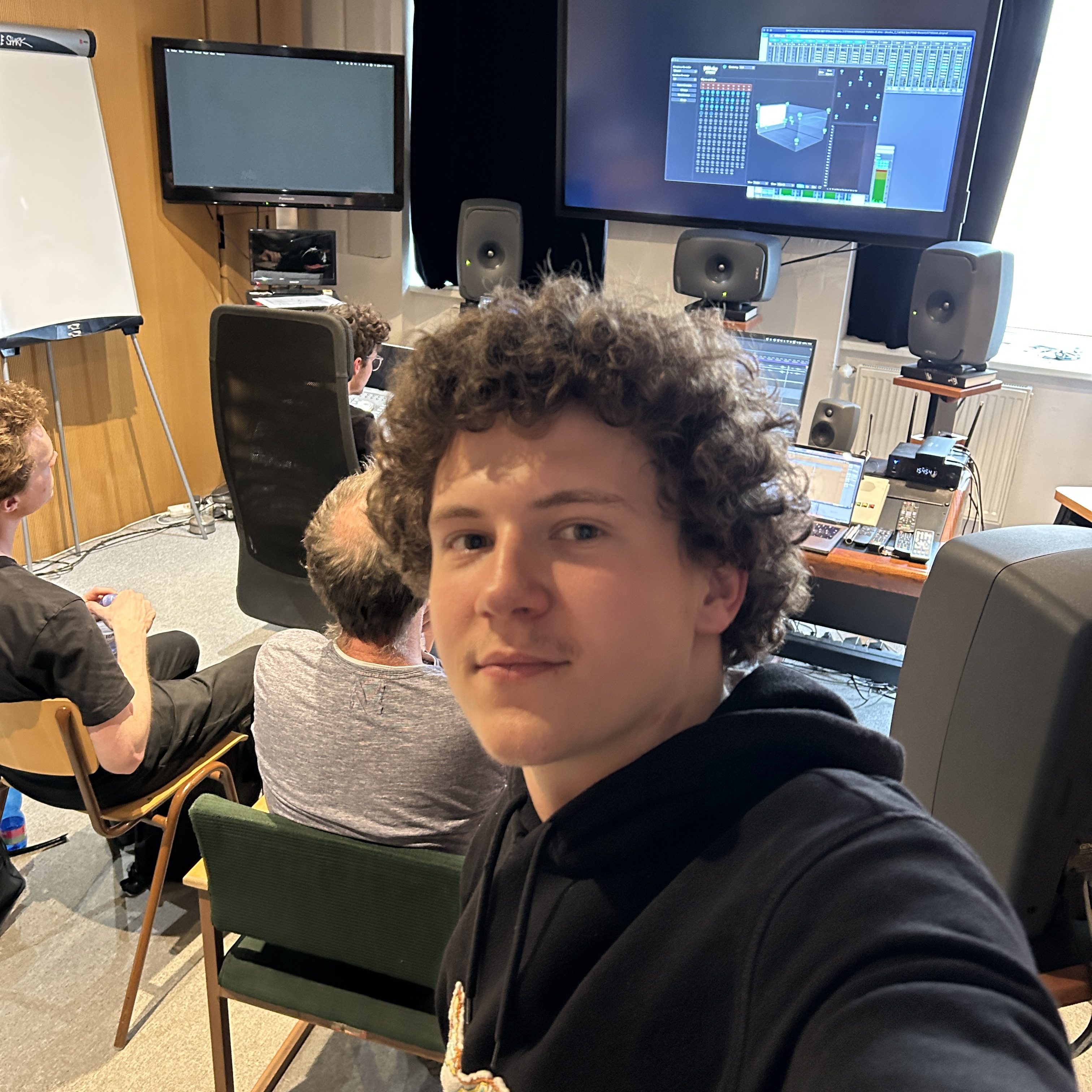
7th of May, 2025
On the 27th of May, I presented my works to the Department of Music Composition at my college, the Academy of Performing Arts in Prague. After receiving a number of requests to see what I’ve presented, I am displaying some of my major works that I’ve composed throughout the 2024/2025 academic year. Enjoy!
PLAYLIST
ABOUT THE WORKS
1. KONVO
KONVO was the first composition written for a combination of instruments including B-flat clarinet, trombone, cello, and double bass, in conjunction with a quadraphonic electronic setup. The electronics served to expand the sonic space and to provide a more plastic resonance of the acoustic instruments.
While composing, I took into account the space in which the piece was performed – the Faculty of Humanities at Charles University. This building allows composers to use two levels for performances: either from the ground floor or the underground level, where the audience is seated.
The possibility of using both floors offers two types of spatial arrangements; the duration of the notes and their movement through perceived space creates a new layer in the interpretation of the piece. I will briefly present segments of the composition in which I apply these two types of spatial usage.
In the creative process of composing music, it is essential to perceive the acoustic impact of the space in which the piece might be performed. It’s not just about the size of the space or its architectural elements – composers have been working with those parameters since the early days of performed music. It’s more about the potential of the space in relation to the placement of the musicians. How can the additive function of electronics, or the direction the musicians face in relation to the audience, create a contrast that is not immediately expected? I intend to explore this topic in greater depth in my bachelor’s thesis.
2. PERSPEKTIVES/PERSPEKTIVY
In this string quartet piece, I aimed to incorporate newly developed techniques that I had not considered in my previous string compositions (noise textures, glissando motifs in the first violins, tones without a specific pitch). At the same time, I tried to create a kind of organized chaos in certain sections of the piece, where the listener can choose which melody to focus on.
3. RUPTURE
Piece for two grand pianos and small symphonic orchestra. I used the technique of masking, in which the wind and string instruments attempt to complement the resonance of the piano’s strikes. I applied a different version of this technique on the note D7 (d3), where the piccolo and flute create a kind of resonance after the pianist plays it.
Another technique I employed was a heterogeneous structure in rhythmic values. This is most noticeable in the col legno al fine section for strings. The timpani, in combination with the double basses, creates a sort of a sonic “clash” that resonates throughout the entire piece.
4. IT’S YOUR TURN NOW
I created this electronic composition for the first time with the intention of it being used in dance. Collaboration with Samuel Loj, a master’s student at the Department of Dance Production and Choreography, broadened my perspective on how a composition can function within the context of the dance medium. I used violin in combination with an analog bass from the Prophet Rev2 16-channel synthesizer. The dance performance took place on Sunday, March 23.
5. JUMP
In this rap song, I focused primarily on structure, the contrast between density and calmness with a slight tempo change a the end.
Structure of the song:
● Outro
● Intro
● Verse
● Hook
● Verse
● Hook
● Interlude
● Verse
6. VRADIOAKCI (CZECH LANGUAGE)
The aim of the electroacoustic composition VRADIOAKCI is to explore the relationship between access to information through radio and how this access influences our behavior. The piece features five monologues. They are delivered by a man who believes that radio has always served the good of society. However, by the end of the composition, the character comes to realize that society must continue to evolve – beyond the phase of “just radio.”
What would a world without radio look like? Would we be more alone?
 Recording Artist, Composer, Musician